Monday, 16 November 2020

 In which the writing of a musical masterpiece becomes the central focus of a novel


What sparks an author to write a book? Especially a novel-cum true story like Musick for the King.

Is there something the author wants the reader to know?  Is it that we yearn to tell a story?  

In my case, my entire career in journalism, broadcasting and public relations has been spent telling other peoples’ stories. I began my novel-writing career so I could tell my stories; the ones I wanted to tell and, more specifically, the ones I wanted to read.   

After writing three all-fictional suspense thrillers, I knew I had to tell the story of the musical genius who’d fallen from the heights of fame and fortune to the depths of illness, poverty and despair and how he struggled, fighting internal and external demons to climb back to the zenith and public adulation once again. It was a combination of both telling my story and telling someone else’s story.

Musick for the King is the dramatic tale of George Frederick Handel one of the greatest musical geniuses of all time. He was the King’s favourite (King George II) and his rise from the pits back to the zenith is the story of his greatest composition and masterpiece, Messiah.

Messiah is one of the most famous and beloved classical music pieces. People who don't know or appreciate classical music, still are familiar with the Hallelujah Chorus and some of the other powerful numbers in the oratorio. It is performed by choirs and orchestras around the world. It has become a Christmas staple. For many,  Christmas would not be Christmas without mistletoe and Messiah!

There are so many interesting pieces to the incredible true story. A very dysfunctional Royal family, a huge public sex scandal, obstinate opposition from the official church, treacherous attempts to destroy his reputation and so much more. I wonder if it doesn't reflect our own society—stars created, destroyed and then restored, shunning those you disapprove of and trying to undermine them, a fickle public that bounces from one “like” to another. It’s all there.

When such a dramatic story is handed to you, it is difficult to create a fictional piece around it. The old saying that truth is stranger than fiction is most certainly true in this case. So the fiction in this story is the byplay around the central characters; the juicy real people as well as the supplemental—but equally juicy—fictional individuals who populate Musick for the King.

I wanted to create a book that takes you back in time not just with words, but with a feel. Thus, like Messiah, the book is broken into three parts. Each part and chapter follows the old-fashioned approach of previewing (as I did in the header to this blog).

It created an interesting challenge for me as an author. I had to be true to the known facts, to deal with historic people, situations and times. I had to tell a compelling story with real and fictional characters, that would interest and hopefully move and inspire the reader.

From reader responses so far, it seems I have achieved that, and I am pleased and grateful.

The trouble is that with research, writing, re-writing and editing, Musick for the King took several years, crammed as it all was between my other writing projects.

Handel however, took only 24 days to compose his masterpiece.

I’ve got a long, long way to go!

Tuesday, 12 May 2020

How much of "Musick for the King" is real? Questions and answers.


Any time an author sits down to write a novel involving real historical characters as part of the story, the questions come fast and furious. And they are all legitimate. After all, if a reader is investing time (and money) in a story they want, rightly, to know how much is real and how much is fiction.

I wrote "Musick for the King" which was published this April. And, while the book has been well-received, the questions flooded in.

Here are just some of the questions and my answers

.
Q&A with the author
Q.      Who is this book written for?
A.      Musick for the King is for readers who love cracking good stories. It is for those who love historical novels, thrillers, intrigue, inspirational stories, novels about famous people, people who love music and reading about music, fans of classical music, fans of composers, fans of Handel and fans of Messiah.

Q.      Why did you write this book?
A.      I was intrigued by the incredible back story of this magnificent piece of music. I have attended many performances of the work but had no idea of the way Handel fell from the top of his profession to the bottom and then struggled his way back up with. Then, I learned about the story of his lead singer, Susannah Cibber, which seemed to mirror Handel’s own—falling from the top of her career to the bottom, then struggling back up. It was a story that cried out to be told!
Q.      How much of this story is real?

A.      About 90 per cent! The story of George Frederik Handel and his struggles to survive his depression and failures is real. The story of how he came to receive the libretto (words) of the oratorio, the fact that he took only 24 days to compose the music, the fact that he spent a winter in Dublin performing concerts and debuting Messiah, is all real. The battle to debut Messiah in London against fierce opposition is also real. The peripheral characters who sought to ruin him and the efforts they made to do so, are fictional. But even then, they too represent reality and truth.


Q.      Who actually wrote the oratorio Messiah?
A.      Handel wrote the music for a libretto (text) put together by a man named Charles Jennens. The entire libretto is merely an arrangement of biblical verses that Jennens wove into the story of God’s relationship and redemption of mankind.

Q.      Did Handel really produce the music in 24 days?
A.      Absolutely! Hard as it is to conceive, he produced the whole composition in that time. He ate little and slept little while composing it.

Q.      Is it true that the author of Gulliver’s Travels tried to stop the debut of Messiah?
A.      Yes. Jonathan Swift, Gulliver’s author, was an Anglo-Irish clergyman, poet, writer and social critic. He was also the Dean (head) of St. Patrick’s Cathedral in Dublin. The church is the Cathedral for the Church of Ireland (Anglican). Handel had arranged to use the Cathedral choir members along with those from Christ Church Cathedral (just a few blocks away and the Anglican Cathedral for the city of Dublin). Swift, who was ill and suffering dementia at the time (he died less than a year later) changed his mind and refused permission for the choir to participate. Without singers, the oratorio was finished. Fortunately, Swift was persuaded to change his mind again and the singers were allowed to perform.

Q.      Who was Handel’s lead singer and what was her story?
A.      Susannah Cibber was an actress-singer who was the pop star of her day. She was the 18th-century version of Lady Gaga, Madonna and Celine Dion together. She wowed her audiences as she performed in London’s popular operas of that day. She had the West End in the palm of her hand. A contemporary said that while others sang for the ear, Susannah sang to the heart. She could move people. She was married to a brute who physically, verbally, mentally, financially and sexually. She left him for a man with whom she had an affair. Her husband Theo sued for divorce and had her charged with adultery. The resulting court case was a very public scandal, covered every day by the newspapers of that time. At the end, while she was indeed found guilty, the court showed its scorn and disgust with Theo by granting him a pittance of five pounds as opposed to the hundreds he demanded. But Susannah’s career seemed to be destroyed. She too was at the bottom. And she too strove to resurrect her career.

Q.      What does this Musick for the King say to 21st-century readers?
A.      I think it is a story of determination overcoming dire circumstances. As we face the Covid 19 crisis today, it shows us that even when things seem bleak, even when we are isolated, and even when we feel depressed, we can overcome. Through determination and just plain doggedness, we can meet the challenge head-on and even in our own small way, achieve great success. It is a reminder to us all, to never give up.


Tuesday, 14 April 2020


HOW YOU RESPOND NOW WILL DETERMINE HOW PEOPLE RESPOND TO YOU THEN


This is one of a series of posts providing help to churches and small non-profits cope with the impact of  Covid-19 on their operations, image and reputation. More information can be found in an online video certificate course I prepared for Plan to Protect (www.plantoprotect.com). It's an organization providing training and resources for churches and organizations that deal with vulnerable people.

As we struggle through the Covid-19 crisis, there are lessons to be learned whether you operate a major corporation or ministry or a local church, school or mission.

Simply put, how you deal with the present will determine how others deal with you in the future.
It has been interesting to watch major brands work their way through this crisis. How they respond teaches us all lessons of how, and how not, to do it.

I see lots of ads and PSA’s thanking everyone from medical staff to truck drivers to grocery store clerks for serving us and helping us. That’s good. And certainly well deserved. One fast food chain has its spokesperson somberly and trying to do so seriously. Other brands are pumping out positive messages along the line of “we’ll get through this if we work together.” Still others brag about how they are sanitizing everything and anything.

But the brands that are beginning to stand out are those that do more than talk and posture. They are actually doing something tangible and meeting people where they have needs. Tim Hortons (which has taken some PR hits over the past few years) has very quietly been sending out vans loaded with free coffee and goodies to local hospitals to help ER and ICU staff get a small break from the intensity of their days. A number of major hotel chains—particularly those with facilities close to hospitals—are offering hospital and medical staff free rooms, realizing that those people cannot go home for fear of infecting their families and loved ones. Sunwing Airlines (another brand that has a poor reputation) offered all its unused inflight meals to local food banks and shelters after their operations were shut down. Loblaws raised wages for both store staff, shippers and stockroom staff. Normally they are all minimum wage employees. Ford is relieving payments for three months and giving another three months on top for anyone having financial difficulties and struggling to meet car payments. Even the maligned telecoms have eliminated data overage charges during the crisis.
All of these had one thread in common: they not only expressed thanks and care, they acted on it.
Part of crisis management is learning from an existing crisis and then applying the lessons learned to future actions. The goal is to create or reinforce an organization’s reputation so that it mitigates the negative impact of any future situation.

The question is, what are you doing in response to Covid 19? How are you being perceived by the people around you and the people watching you? In the online video training I did for Plan to Protect, I talked about this post-crisis situation and how it really should be a pre-crisis mentality. My reporter friend Dan Brown of the London Free Press said it succinctly. “If you are only calling me after the crisis to cover you, or if your first contact with me is in the middle of the crisis, you have done yourself no good whatsoever.” As I said in that module, people are carefully weighing your words against your actions; they want to know if your deeds reflect your values. If they do, you will gain strong support. If not, you will be scorned and ignored.

Your response in crisis is critical. Pun intended!

If you are just expressing concern and doing online contact with your people that’s good, but not enough. No matter if you are a denomination, a local church (large or small), a school, a camp, a multi-site operation or a small local mission, you need to act.

Some churches are stepping up efforts to work with homeless or vulnerable people, from providing food supplies to buying or creating masks and other sanitary supplies. Congregation members order food online from local groceries for pickup at the store; it is then delivered to the receiving agency. Others are providing assistance and materials directly to front-line hospital workers or their families, checking in with them, providing support and encouragement as well as necessary supplies.

Letting the local community know and enlisting their help as well sets a deep impression into the community psyche. Is there equipment, are there facilities or supplies you could donate to front line services? How can you provide practical help no matter what kind of organization you represent?
People also watch carefully how you treat your employees as well as your members, clients or adherents. They find out directly from the employee or the families how well or how poorly you treated them in the crisis. And the people remember. We may be a wired society, but the gossip lines are still potent. It’s just that they are more likely to appear on Facebook, Twitter, and other social media outlets. And when we’re allowed to gather again, the tongues will wag.

Financier Warren Buffet said that it can take an organization 20 years to build a reputation, but it can be destroyed in 20 minutes.

What kind of an image do you have now and what kind of reputation do you want to have when the world gets righted? Are people going to feel good about you or will they be turned off.
Even as this crisis continues, you have choices to make. Good leadership is all about not just handling the present, but projecting into the future and setting things in place to lead your group into a stronger position where you are better accepted by the community and having a stronger impact upon it than you did before.

Be that kind of leader!


Thursday, 21 June 2018

Book locations 6: The Welsh Valleys

Where are the books set? And why?
A series about locations in my books
(The Excalibur Parchment, The Lucifer Scroll, The Prince Madoc Secret)

Part Six: The Welsh Valleys
        In the south of the little nation of Wales, not that far from the English border, is a series of valleys stretching up into the mountainous areas of the Brecon Beacons from the flatter coast plain that is called the Vale of Glamorgan. These are the famous Welsh Valleys.

          For many years they were associated with the coal mines that dotted the entire area. Books and movies were made documenting the valleys, most notably the book, later a film “How Green was my Valley.” The coalmines closed—the last one in the early 90’s. The area became woefully depressed and poverty and joblessness was too often the norm.

Its not just coal! The Valleys have also given the world magnificent music, wonderful hymns, great physical beauty, some of the best rugby players in the world and a lively, friendly culture that transcends the difficulties and exhibits life in the full.

The names evoke pictures of coal-smeared miners, metal helmets with minion-like lenses, emerging from metal-crate elevators arising from the bowels of the earth: names like Rhondda, Taff, Ebbw, Cynon, Llynfi and others.

It is an area of resourceful people. Tough people. Caring people. It is an area of great beauty. Steep valley sides are dotted with rows of stone miners’ cottages climbing up the valley as it gets narrower and narrower. Once huge piles of coal slag are now emerging as green landscapes because of regeneration projects. Rivers flow. Trees grow. People who once looked out on scarred, coal smoked visages now enjoy verdant green settings and new forests emerging.

It was this setting that propelled the stories along. The area is rich in history, dating back well before Roman times and stretching into the post-Conquest Norman period. Warfare and rebellion are embedded in the psyche of the Valleys. Stories abound of magnificent victories over the English invaders. And magnificent losses. But ultimately it is a story of reconciliation and living together, however reluctantly and that marks the Valleys.  It’s why the Valleys are so important in the stories. They are stories about centuries-old Christian monks and modern-day faith seekers; stories about diabolical supernatural evil and stories about individuals struggling, reluctantly and sometimes without hope, to save what was important and protect the heritage they were given.

My fictional 12th century abbey, Cymllyn was set here. The courageous monks Thomas and Owain struggled through this rugged landscape. A hilltop church, based on the one at Llangynydd, becomes a focal point in the battle for Excalibur.

Just south of the Valleys are the cities of Cardiff, capital of Wales, and Swansea, packed with historic sites, great restaurants, museums and cultural icons are certainly well worth the visit.

But don’t stay in the cities. Explore the Valleys themselves and reward yourself.

Mountain tops. Villages. Row houses. Vast moorlands. Picturesque churches and farms.

The Welsh Valleys. 

Well worth crossing the Severn River for.


Saturday, 2 June 2018

Locations in my books: #5 London

Where are the books set? And why?
A series about locations in my books
(The Excalibur Parchment, The Lucifer Scroll, The Prince Madoc Secret)

Part Five: London
          
     Samuel Johnson famously once said that if a man is tired of London, he is tired of life. 
     What applied in the 18th century also applies today in the 21st. London is a vibrant city that fires the imagination just by its very presence; you cannot get tired of London because you cannot explore all the city has to offer—history, architecture, art, culture, dining, diversity, markets, business, parks, pageantry—and a whole lot more.

          London is a major world city. Its influence and attraction extends beyond the white cliffs of Dover. It is a centre of intrigue, passion, excitement, busyness and colour. You find the world living and vibrating on its streets.  It is the heart of democracy—from Magna Carta to the current constitutional monarchy—and is an example to the world of how to “do” democracy—with all its flaws, corruption and failings. (Former Prime Minister Winston Churchill said that democracy was the worst form of government—except for all the others!)

          No wonder London is a prime setting in all three books. It is the heart of government—a government that is under attack from terrorists of all stripes, including my evil Druids. From the pomp and ceremony of the opening of Parliament (The Excalibur Parchment) to the machinations of an egotistical self-centred politician concerned with his own agenda instead of public service (The Prince Madoc Secret), the stories cannot be set in any city other than London. It brings together the “good guys” and the “bad guys” and gives them a stage to operate on.

          The Houses of Parliament rise majestically on the banks of the Thames River (if you go, the best view is from the London Eye across the river) and has been the target of numerous terrorist attacks from the days of Guy Fawkes who tried to blow up Parliament (1605) through to the attacks in 2017.

          Not far away is Buckingham Palace, a reminder of the stability of the British monarchy, but also the symbolic home of the Queen and the Royal Family, themselves often threatened by terrorist plots from foreign sources and homegrown alike.

          Beyond the historic sites like the Tower of London and magnificent churches such as Westminster Abbey and St. Paul’s Cathedral, there are many more interesting corners, hidden treasures and fascinating places to grab the visitor’s attention.

          London is such a magnet that the “real London” often merges in the mind with the fictional London from the thousands of books set in the city or the thousands of movies and television programmes that have been shot on its streets. Baker Street is real—but also, at 221b, the home of Sherlock Holmes and Dr Watson. Notting Hill is a real village in the heart of the city, but also where Julia Roberts and Hugh Grant met in a bookstore. The list goes on.


          Do you fancy shopping or street markets? By all means go to Regent St. and Oxford St.--the main shopping streets/ But don't miss out on the smaller sites. Try Petticoat Lane or Portobello Road. Or go to the Borough Market, Spitalfields Market and Covent Garden. Are shows your thing? The West End theatres feature top hit shows and lesser-known—but equally enjoyable—productions. Don’t miss Agatha Christie’s The Mousetrap, for example, which opened in 1952 and has run continuously ever since to packed houses.

          Seeking peace and quiet? How about the many parks where you can rent a deck chair and relax surrounded by green and away from the hustle and bustle of the city. Hyde Park, Green Park, St. James Park, Regents Park, Hampstead Heath—all free and all inviting.

          There’s the popular sightseeing London—Westminster Abbey, St Paul’s, the Tower, Buckingham Palace and so on. But there’s also the literary London, the artistic London, the musical London, the shadowy London—whatever interests you have, London provides a bountiful plethora of places to go, things to see and things to do to meet your own particular areas of interest.

          In short, Johnson was right. There is so much to do and see in London, you can never get bored. Since Roman times it has been a hub drawing people from all over the world and all walks of life.  In other words, a perfect setting for a myriad of stories—mine included.


          You owe it to yourself to visit this great city.

Saturday, 26 May 2018

Book locations #4 St David's Cathedral

Where are the books set? And why?
A series about locations in my books
(The Excalibur Parchment, The Lucifer Scroll, The Prince Madoc Secret)

Part Four: St. David’s Cathedral
          Tucked away in the far south west corner of Wales is Britain and Europe’s smallest city, St. David’s.

          It has a population closing on 2,500 residents, a few shops, some restaurants and pubs and, hidden in a small valley below the city, the immense and impressive St. David’s Cathedral.  The village (because that’s what it really is) is called a city because of the Cathedral. Ecclesiastic law and history determined that no matter how big or small, any place that had a Cathedral was declared a city.

          St. David is known as the Patron Saint of Wales and has an incredible story—worthy of a book—of his service to Wales in preaching and teaching Christianity. Legends suggest that St. Patrick, of Ireland, was taught by David. His preaching was renowned. Thousands gathered to hear his sermons. Miracles were apparently done in his name.

          And so, the Cathedral was built to honour him and to hold his tomb.

          It’s nestled in a narrow, sheltered valley for a reason. In the so-called Dark Ages (mid 500’s and on), Viking marauders attacked and destroyed churches along the coastline, killing all the monks and sacking nearby villages and enslaving its inhabitants.

          St. David’s hidden location saved it from such deprivations and allowed it to prosper. By the time of William the Conqueror (1066), such was the fame of the Cathedral that a Papal decree dictated that two pilgrimages to St. David’s was the equivalent of one pilgrimage to Rome. William himself made a pilgrimage to the Cathedral in 1081.

          Beside the Cathedral itself are the massive ruins of the Bishop’s Palace, indicative of the wealth of the Cathedral in medieval times. During Henry VIII’s dissolution of the monasteries it suffered heavy damage but survived and serves today as an active church and diocesan centre for The Church in Wales (part of the Anglican Communion),

          The best view of the Cathedral is from the old stone gateway and bell tower atop the hill by the village. From there you can see the sweep of the valley and the church’s strategic placement.

          Stained glass windows and decorative features abound in the Cathedral. If you’re lucky and it is not church service time, you still might hear the organist or even catch the Cathedral choir practising.

          In The Prince Madoc Secret, the Cathedral plays a key role. But I postulate that, at the critical time in the novel, the Church and the cultural community have gathered to create a special memorial place for Welsh writers, artists and musicians might have their own ‘Poet’s Corner’ such as found at Westminster Abbey in London.


          That is one piece of fiction I’d love to see become reality.

Saturday, 19 May 2018

Locations in my books: Istanbul

Where are the books set? And why?
A series about locations in my books
(The Excalibur Parchment, The Lucifer Scroll, The Prince Madoc Secret)

Part Three: Istanbul
In The Lucifer Scroll, an archaeological dig unearths a tantalizing document that hints at the existence of a revered icon, the Holy Lance also known as the Spear of Destiny. It was the spear that a Roman centurion thrust into the side of Jesus Christ at the crucifixion. But it became a spear immortalized by future generations as an icon that allowed its holder to rule the world.

Certainly, Charlemagne and Napoleon believed it and sought it. Adolf Hitler lusted after it. He sent his occult-loving SS chief, Heinrich Himmler, on a search for the spear. Hundreds of thousands of Deutsch Marks were spent on the search, even in the middle of World War II.

One of my protagonists, Professor Huw Griffiths, flies to Istanbul to help an old friend excavate and interpret and old church building they’d discovered in the midst of a huge industrial dig to create a new subway line in the city.

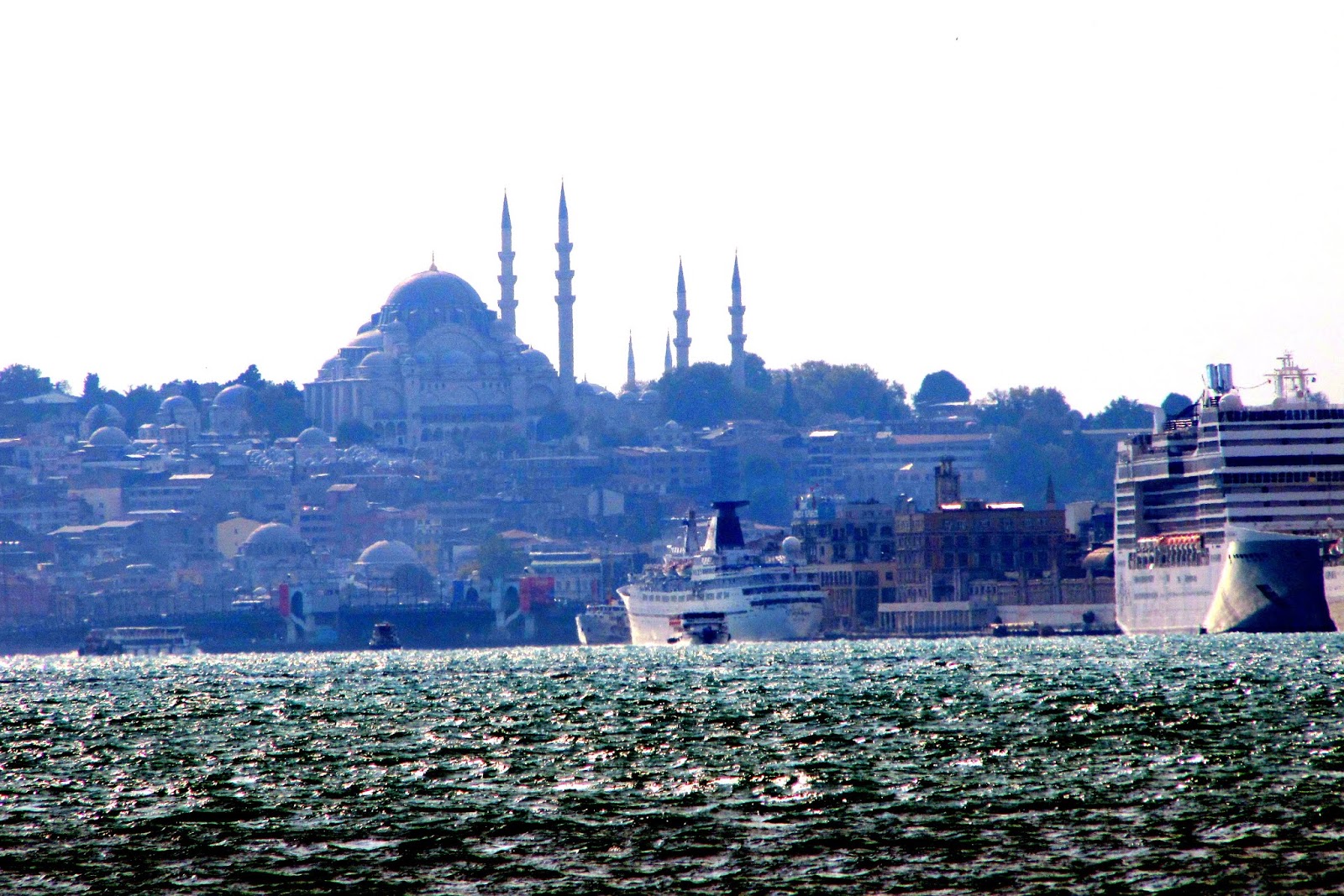
Istanbul is an incredible city, layered with history and tumultuous events, magnificent structures dating from Byzantine times as well as Ottoman. The city straddles the Bosporus, a sea channel connecting the Black Sea and the Aegean. The Bosporus also divides Europe from Asia.

Huw’s church dig symbolizes the city’s violent past, dating from its destruction during the Ottoman invasion of 1453. Hidden beneath the marble altar he finds the provocative document that sparks the new hunt for the spear.

Istanbul is a city of contrasts. Modern high rise office towers sit side by side with white marble mosques. Crowded city streets open into magnificent park-like squares. Modern shops on modern streets lead to the tumult and noise of the Grand Bazaar or the Spice Market. It’s noisy and bustling. And it is quiet and reflective.

High above the old city, on the south side of the famed Golden Horn lies three of the city’s most historic and amazing structures.

Hagia Sophia, an enormous Byzantine Cathedral draped in magnificent décor and once the largest building in the world. Still amazing to see and walk through some 1500 years later. It passed from the Byzantines to the conquering Ottomans who were so awed by the building they turned it into a mosque. It now exists as a museum, open to the public and delicately showing off both the incredible mosaic work of the Byzantines and the scrollwork art of the Muslim tradition.

Hagia Sophia sits between two superb Muslim creations: Topkapi Palace and the famed Blue Mosque which is sparkling white marble. (It’s called the Blue Mosque because of the predominant blue and turquoise décor inside the structure).

Topkapi was the palace of the Ottoman emperors until they moved in the late 1800’s to a newer, more modern structure further north along the Bosporus, called Dolmabahce Palace.

Linking Topkapi, Hagia Sophia and the Blue Mosque is the park-like Sultanahmet Square which itself also takes in part of the old Byzantine Hippodrome.


History. Culture. Museums. Clashing faiths. Istanbul was an easy choice for a somewhat mysterious, challenging, evocative location to begin the hunt for the Lucifer Scroll.